
Yarn Substitution
Going off-pattern with your yarn choices

Despite patterns including yarn suggestions, you don’t have to use the same yarn as the designer and can swap one for another.
There can be all manner of reasons why you may want to swap the yarn:
the recommended yarn is no longer available
you fancy a different look
you want to use yarn from your stash
you have fallen in love with another yarn
you feel adventurous and want to mix it up
There are a multitude of knitting adventures to be had if you are keen and like to experiment. Exciting journeys come with a little risk and sometimes they don’t work out, but taking the first step can be half the battle.
If you want to sub the yarn, here are some helpful points:
The Ball Band:
Here you have all the info you need in one place:
How many metres per 50/100g
What is the Fibre content
What is the construction - Lace, 4Ply, DK etc. and is it worsted or woollen spun
Recommended Needle Size
Ravelry:
If you are unsure what other yarns might work for your pattern, you can scroll through the projects on Ravelry to find a magnitude of other options.
What do you like:
What you like or don’t like to wear matters! Maybe the pattern says 100% Wool, but you don’t like wearing wool - try something different, be brave.
Fibres behave differently:
Swapping wool for mohair or linen won’t give you the same result and that’s absolutely fine if you are aware of it - the mantra I follow is: swatch, swatch, swatch.
Swatches:
The designer gives you the gauge of the pattern as shown so that you can achieve the fit and drape that they intended the knitted fabric to have. Use this as your guide when experimenting with other yarns. The goal of swatching is to simulate the fabric of your finished garment as closely as possible. For this reason, it is important to knit your swatch under the same conditions you will knit your project, using the same size and material of needles. Always wash and block your swatches and measure them before and after blocking.
Many knitters make their swatches too small, leading to inaccurate gauge readings. In order to measure your knitting tension correctly, you should try to make your swatches 15-20cm square.
It is important to accommodate for uneven stitches at the edges of your swatch by using a 3-stitch garter edging on either side and 4 rows of garter stitch at the top and bottom.
An easy way to calculate the number of stitches to cast on for your swatch is to take the number of stitches per 10cm recommended in the pattern and multiply it by 1.5, then add 6 stitches to that number for the garter edging.
Most knitters will find that their gauge in the round differs from their gauge when knitting flat. If your project is knitted in the round, don’t knit a flat gauge swatch – it won’t be accurate enough.
Here is my method of swatching in the round:
Cast on your required number of stitches using a circular needle and work the first row.
Without turning your work, slide the stitches (with the RS facing you) to the other end of the needle.
Your yarn will be attached to the last stitch on your needle, so carry it loosely behind the swatch and work row 2.
Repeat steps 2 and 3 until you have completed the swatch.
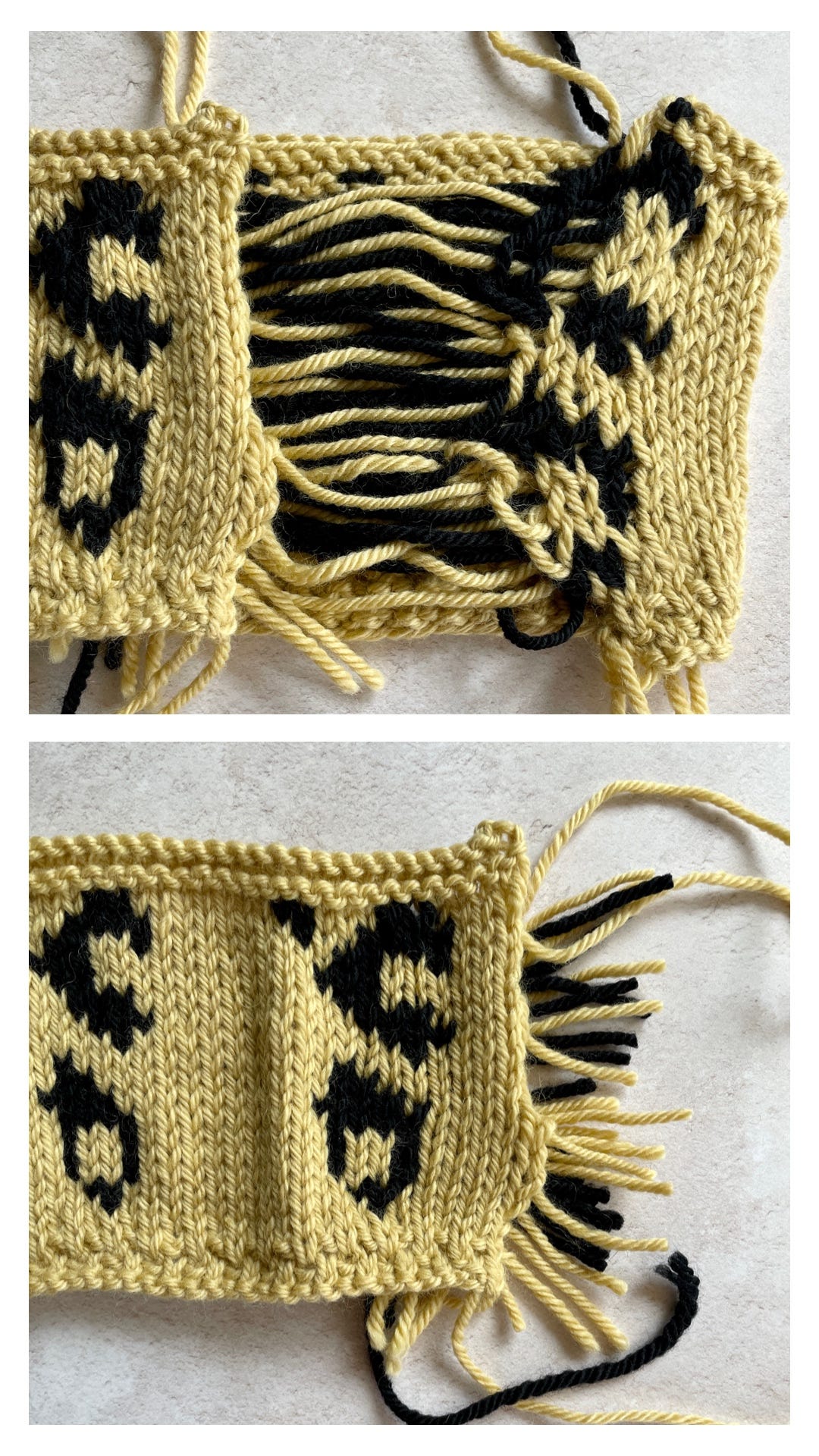
Next: Tighten up the edge stitches as you go along by tugging on the loops. Once you have bound off, cut the loops (in the middle) at the back of the work and tighten them up a final time before blocking.
Using this method, you will get an accurate swatch of your gauge when knitting in the round.
If you found this little guide to yarn sub helpful, please share or give it a little like below. Thank you.
See you next week when I will guide you through more yarn sub with crunching numbers.
Take care, Heike xo
Excellent advice. I often switch out the recommended yarn for my handspun. I can get pretty close to the recommended size on my wheel.
I do confess to living on the edge and I don't swatch! LOL!
What a useful article, for knitters of all abilities. I always swatch, as I'm a slow knitter and if I have to undo, the project stands a big chance of arriving in Frog City. I never use recommended yarn, as I rarely have it, but getting gauge is more or less always possible. If it is a bit off, I try needles which are made of a different material. Silk is so much more stable on bamboo, for example